Anchor chart maker for reading, writing and math
Describe the chart your lesson needs. Print it as a poster, or put it on the board.
Make an anchor chartAn anchor chart holds the one idea students keep coming back to: the elements of a story, what each digit in a number is worth, or the job of a noun, a verb and an adjective. Teachers usually draw them by hand on chart paper the night before. TeachFigs gives you a clear, colorful version from a short description, so you can spend that time on the lesson.
Describe the chart in plain words: the heading, the sections, and a short line and a small picture for each. Put the words you want printed in quotation marks. For example: "Story Elements" with sections for characters, setting, problem and solution, each with a picture from one simple story. The K-12 textbook style gives the bright, hand-lettered look of a classroom chart. The three charts below were made this way, and each caption shows its prompt.
Use it the way you use any anchor chart. Print it as a poster for the wall, print smaller copies for students' notebooks or desks, or put it on the board or a slide during the lesson. A portrait 3:4 shape fits chart paper and letter paper. For a very large print, choose a higher quality before you make it.
Anchor charts work in every subject: story elements, parts of speech, and writing steps in reading and writing; place value, fractions, and problem-solving steps in math; map skills and branches of government in social studies; classroom routines and feelings in the morning meeting. Science charts work too.
Read every word before the chart goes up. Image models can misspell a word, change a number, or draw the wrong count of blocks. On the place value chart below, check that there are three hundreds, five tens and two ones. If something is wrong, change the description and make it again.
Example figures
Prompt
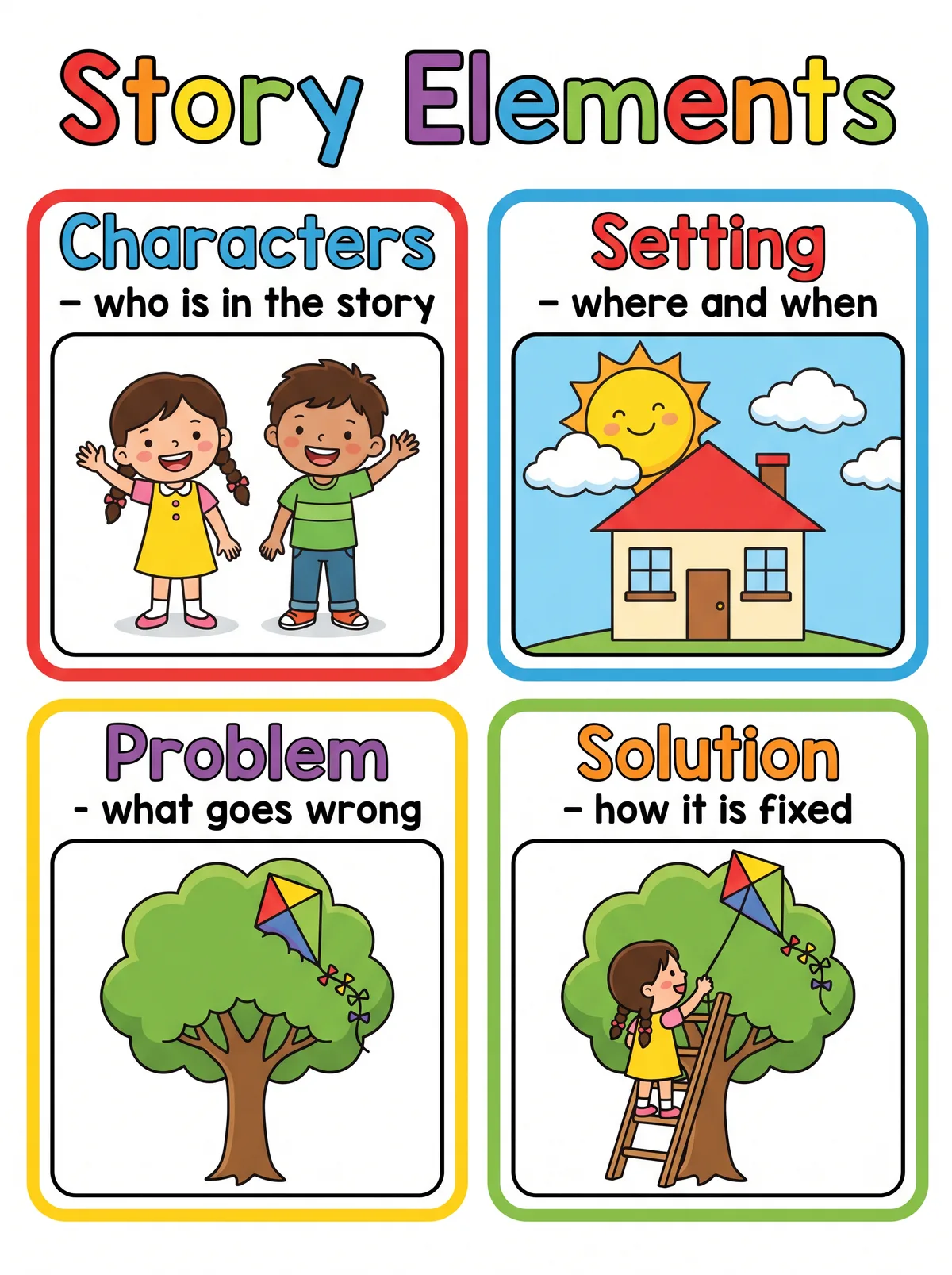
K-12 Textbook style, 3:4. Prompt: A classroom anchor chart filling the whole image as flat digital art on a plain white background, with no tape, wall, cork board or photo edges, and every drawing complete inside its box. Headed "Story Elements" in colorful marker-style letters, with four color-coded sections: "Characters - who is in the story" with two simple children, "Setting - where and when" with a small house under a daytime sun, "Problem - what goes wrong" with a kite stuck in a whole tree, "Solution - how it is fixed" with a child on a ladder getting the kite down from a whole tree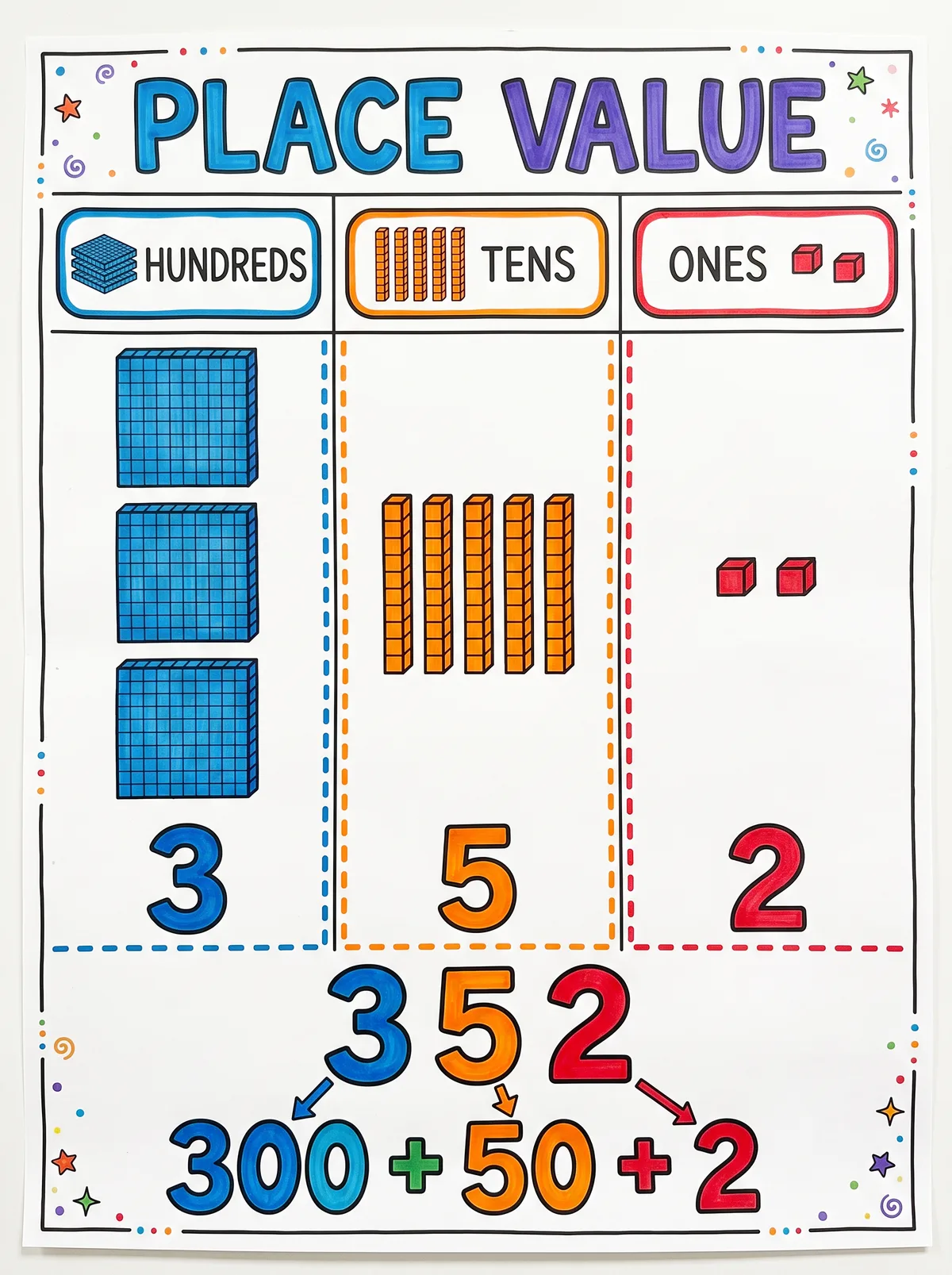
Prompt
K-12 Textbook style, 3:4. Prompt: A classroom anchor chart on white chart paper headed "Place Value", marker style, with three columns headed "Hundreds", "Tens", "Ones". Under Hundreds: 3 flat squares of base-ten blocks and the digit 3. Under Tens: 5 long rods and the digit 5. Under Ones: 2 small cubes and the digit 2. At the bottom in large numbers: "352" and "300 + 50 + 2"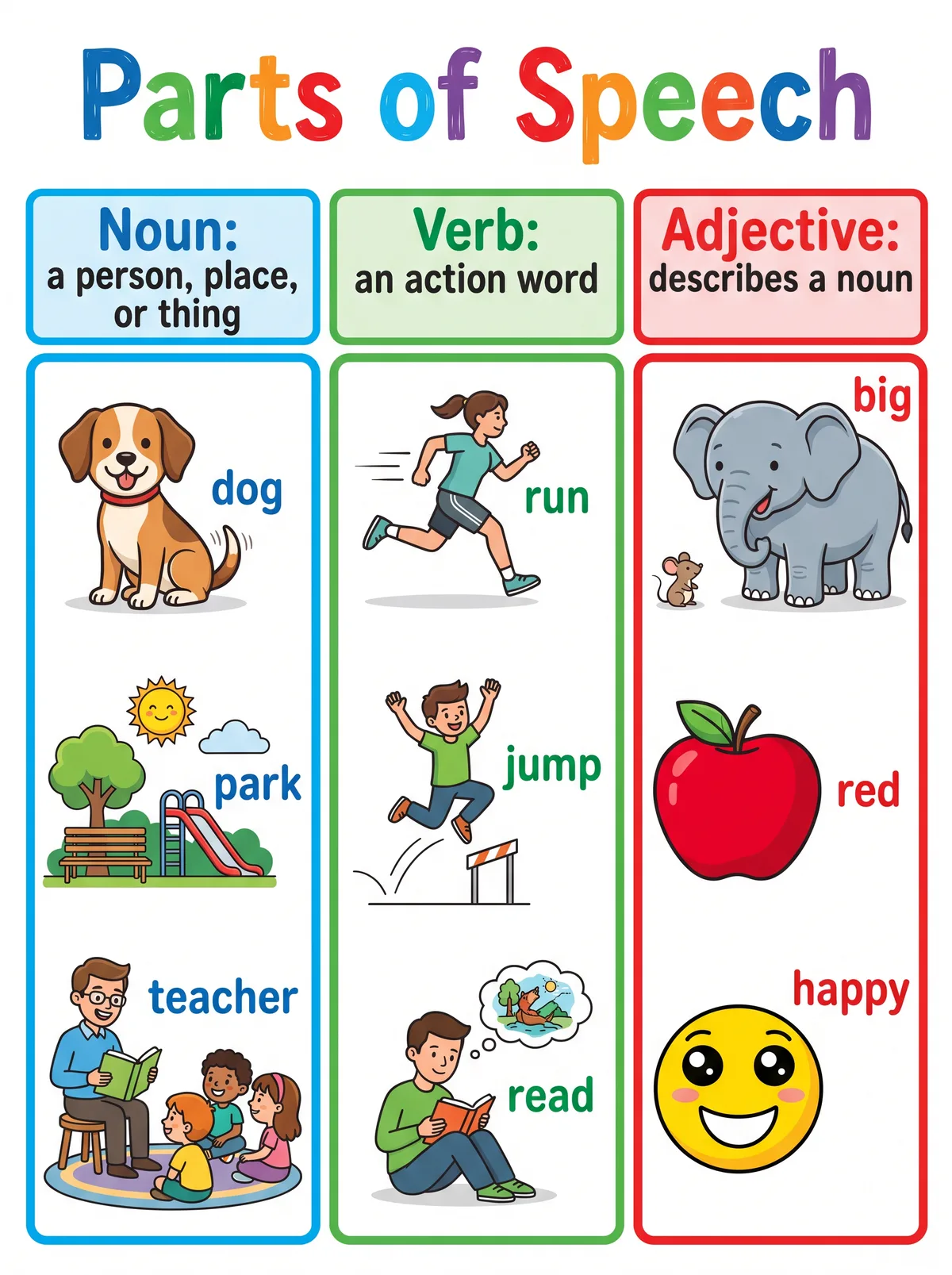
Prompt
K-12 Textbook style, 3:4. Prompt: A classroom anchor chart filling the whole image as flat digital art on a plain white background, with no tape, wall, cork board or photo edges. Headed "Parts of Speech" in colorful marker-style letters, with three color-coded columns. "Noun: a person, place, or thing" with the words "dog", "park", "teacher", each beside a small picture (the teacher is a man reading a book to children). "Verb: an action word" with "run", "jump", "read", each beside a small picture. "Adjective: describes a noun" with "big" beside a huge elephant next to a tiny mouse, "red" beside a red apple, "happy" beside a smiling face. Every picture has its word next to it; no extra picturesHow it works
Describe the chart
Give the heading and the sections, with a short line and a small picture for each. Put the exact words you want printed in quotation marks.
Choose a style and shape
K-12 textbook gives a bright classroom-chart look. Choose portrait 3:4 for chart paper or letter paper, and a higher quality for a large print.
Check every word, then print or project
Read every word and number. Print the chart as a poster or a student copy, or put it on the board during the lesson.
What anchor charts can I make?
Any chart you can describe: story elements, parts of speech, the writing process, place value, fraction models, problem-solving steps, map skills, classroom routines, feelings, and science ideas. Name the heading, the sections and the words to print.
Can I print it as a large poster?
Yes. Choose portrait 3:4 and a higher quality before you make it, then print it on a poster printer or with your printer's poster setting. Smaller copies work for student notebooks.
Can students color it in or fill it in?
Yes. Ask for a black-and-white version with empty boxes, or use Worksheet mode to make a fill-in student page with a matching answer key.
How do I make sure the chart is right?
Read every word and check every number and count against your lesson. Image models sometimes misspell a word or draw the wrong number of items. Change the description and make it again if anything is wrong.